

Notes from the Ineffable: Part One
Blog | (House-)Museums | Photography | Memories | Presence


Although I suppose it isn’t the most untranslatable word in Italian, I still find it hard to convey the density and nuance of commosso.1 In English, you can say that something or someone “moved you” or “touched you.” But as a more than a bit of a grammar nerd, I like the inherent shape of the word in Italian that shows you are moved actively “with,” not just passively “by” something or someone. Whether it’s a piece of writing or a painting or a sculpture, or a person, or a seascape or a mountain view, it seems to me that in Italian it is both the subject and the object, the viewer and the viewed, that are set in motion because of feelings of intense joy or intense sadness, or sometimes even a combination of the two.

A Trip to the Frick Sparks Some Considerations on Photography
Can revisiting a place, even a public one, transport you back in time, not necessarily through the ages via the artists’ paintings and sculptures, but to an epoch of your own personal history?
Ever since I visited Federico Garcia Lorca’s Huerta de San Vicente house in Granada, Spain, (and was even invited to tickle the ivories on his piano but I was far too shy to take up the offer!), I’ve kept soft spot for house-museums. Even the Museum of Innocence, which Orhan Pamuk brought to life after and while he was writing the novel of the same name in İstanbul, is a place I find filled not just with personal artifacts of fictional characters, but with truths.2 While I’ve enjoyed visiting with friends or as a solo traveler the house-museums of Giacomo Puccini in Lucca (Tuscany), Giacomo Leopardi in Recanati (le Marche), Saint Catherine of Siena (Tuscany), Dante in Florence (Tuscany), I always feel the one that got away was that of Eugenio Montale in Monterosso, one of the Ligurian coastal towns of the Cinque Terre. In late September of 2018, the day I took the train from Florence to the Cinque Terre was a Sunday and Montale’s house-museum was indeed closed.
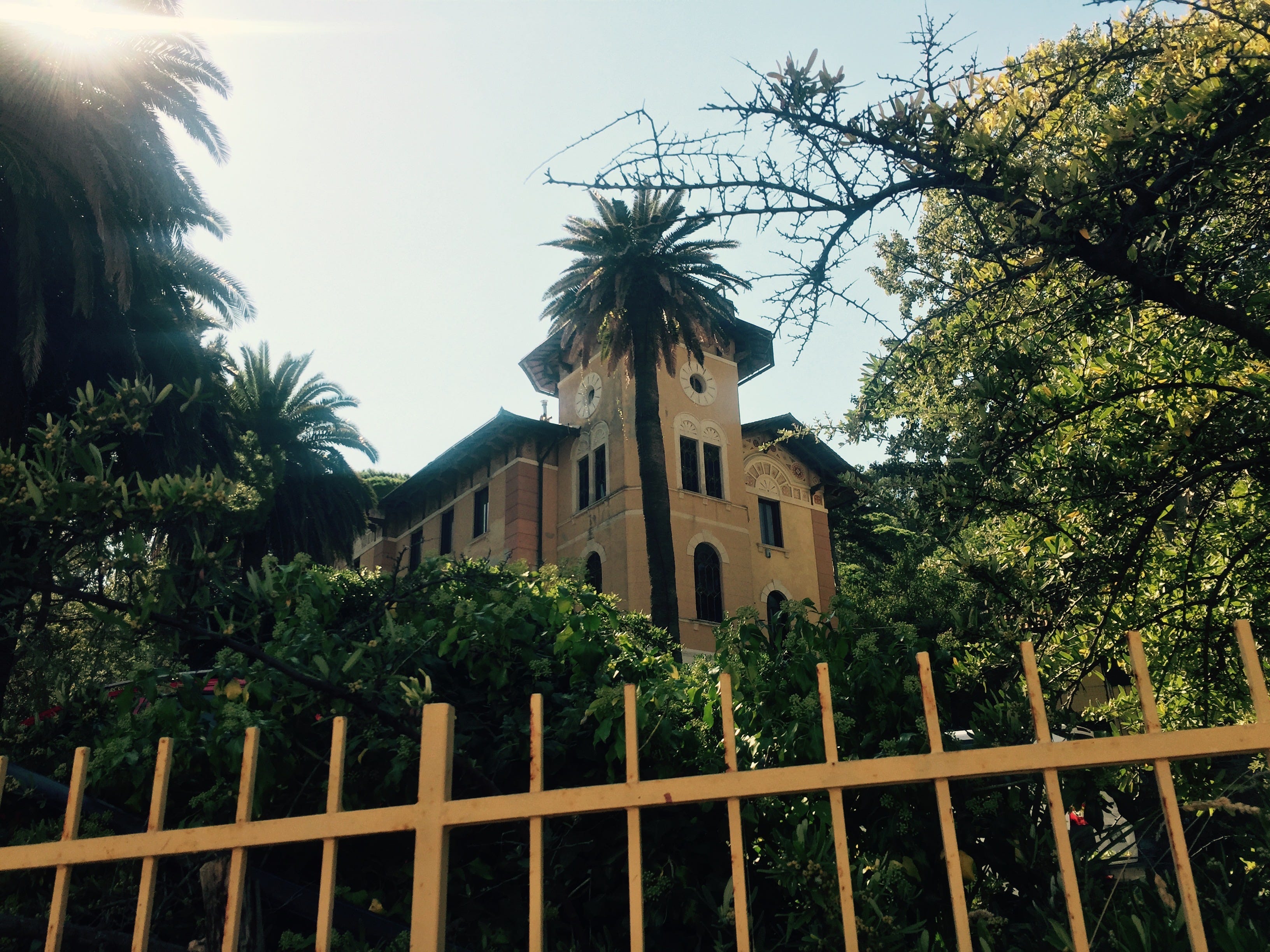
But as Alexander Graham Bell once said, where one door closes, another one opens. Although I couldn’t visit Montale’s house that day, I had extra time and that trip started my love of long walks. The walk from Vernazza to Corniglia, often with no railings along steep cliffs overlooking gorgeous Ligurian coast below, is something that has stayed with me. I promise I’m not just joining in the pilgrimage and walking-tour trends, but I do think the uptick in interest is indicative that people are tired of the same hit-and-run travel experiences, of the tourist traps they fall in to. Maybe not everyone can become an explorer, but I think more people would rather be travelers than tourists and thank goodness for that!


Stepping away from this brief trip down memory lane along the Ligurian coast, this August I felt like my feet can hold memories just as well as my heart and soul can. When I revisited the Frick Gallery at the beginning of August, my feet felt the green carpets that were no longer over-trodden and beaten, but plush and inviting. I was surprised, and also not, that I found myself holding back tears as I gazed around this unabashedly not modest house-museum. It wasn’t because I hadn’t been back since my freshman year at New York University (in 2008!). But with this trip in particular, I felt like I was no longer a day-tripping interloper asking for crumbs. I had unapologetically reclaimed my love of picture-gazing in a place ever so slightly off the beaten track.
Besides the renovations,3 which have been detailed in many a magazine and newspaper as well as chronicled on the Frick’s website and socials, and as reading Gaston Bachelard’s The Poetics of Space or Italo Calvino’s Invisible Cities among other books can tell you, space is an inhabited experience. But more than that, what I found most refreshing about this trip to the Frick was something I did not expect: their no photography policy.
I don’t know if that’s always been the case, or something they implemented for the reopening. Or maybe the selfie snafu at the Uffizi Galleries in Florence this past June when a museum-goer lost his balance and damaged the star painting of the exhibit as he was trying to pose in front of it had something to do with it too. Now, when I go to a museum, you won’t see me shoving my face in front of a Leonardo or a Monet to provide photographic evidence that I indeed was there. I take pictures of the works of art so that I can show them to my friends and family who didn’t get to go to the museum with me. Even if like Mary Oliver wrote in her poem “How I Go to the Woods,” often I too prefer to go for a hike or to museums or to the beach alone, that doesn’t mean I don’t want to at least attempt to share the treasures I’ve found with others:
I have my ways of praying,
as you no doubt have yours.4
Whether it’s at a museum or not, pretty much any time I feel the need to take a picture it is because I’m attempting to extend the experience and its reach beyond that moment and beyond myself.
The atmosphere of not having to jockey around, or be the person people are trying to reposition themselves around while taking a picture, was strangely liberating. I may not be able to replicate the experience by abstaining from taking pictures myself at other museums that don’t have such a policy, but I have to say it has made me want to visit the Frick more often so that I can seek out that kind of immersion.
And yet, believe it or not, I am not actually against photography. I have a nuanced view! I want to re-embrace photography at its Greek etymology, as writing with light.5 If you’ll indulge me in one more brief saunter down memory lane, photography is very special to me. My grandfather, my Poppop, who passed away in 2011, taught me and my sister how to develop our black and white negatives, and then choose the best ones to make enlargements of (also known as prints!) of in his at-home dark room. After being exposed to light they would be bathed in developer, a stop bath, fixer, etcetera.
I remember as a young child, one summer on Cape Cod I decided to go down to the beach after dinner to capture some beautiful sunsets from the local color box to take home, and while I was on the rocks I managed to fall and cut my arm and my leg. There were no broken bones, just a bit of a mess and based on my mother’s reaction, I must’ve been quite a sight! But, there I was, so happy I had gotten my sunset pictures! Well… if memory serves me right, I don’t think my grandparents had come with us on this particular summer vacation, but when my grandfather did hear about my little misadventure, in his gentle but firm manner, he told me something along the lines of “Take pictures, just try not to fall on the rocks.” Wise words indeed. In between the lines and my imperfect memory was something about how my being safe was worth more to him than any picture. Life and love is an experience, and one that isn’t always caught on film or in pixels. In addition to that sweet memory, I also still have the note he gave me with the Nikon N55 film camera6 he gave me for Christmas in 2003:
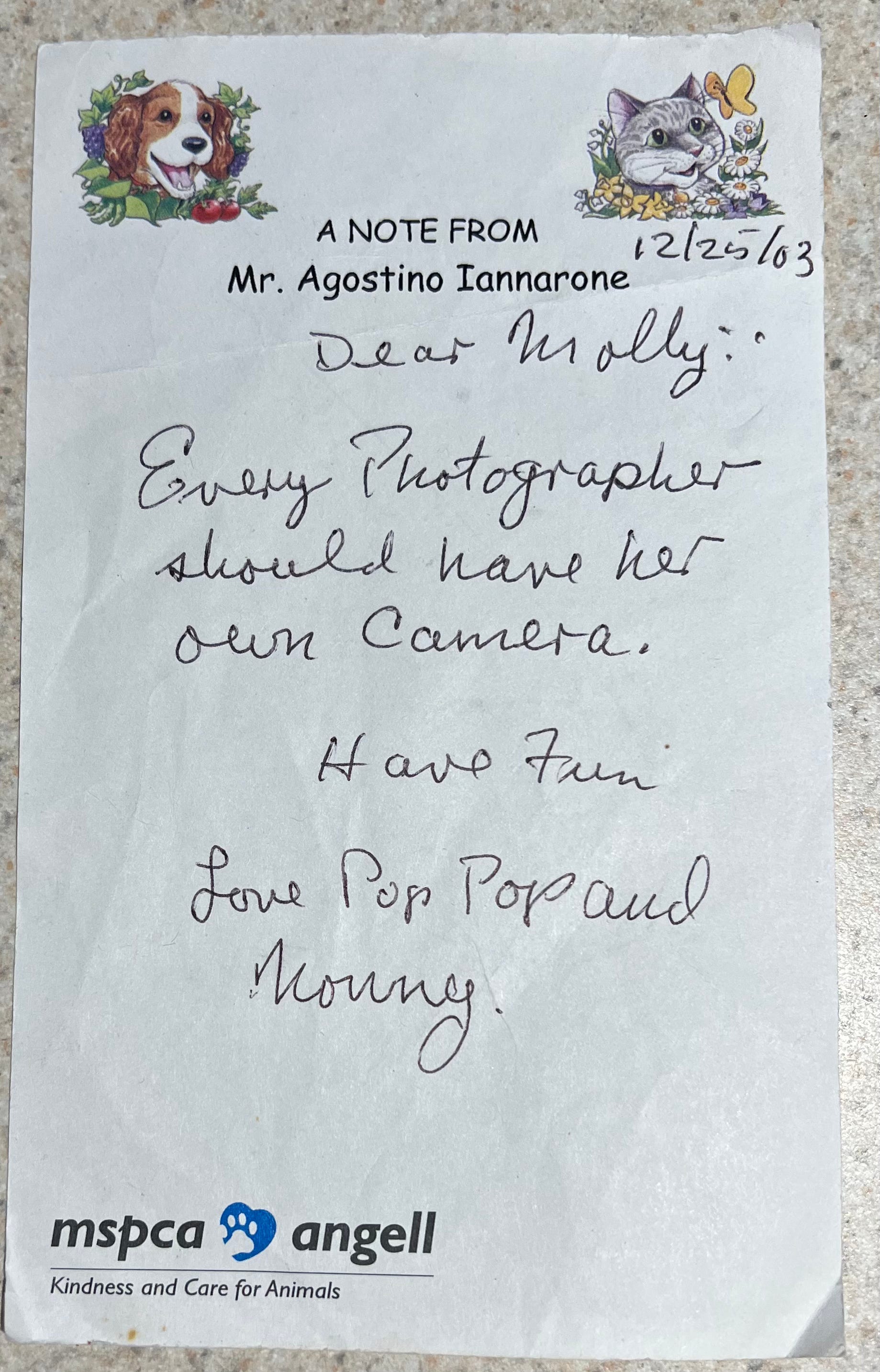
In short, I want my photographs to capture in order to share, not to take or to hoard. So… IF I had been allowed to take pictures, or better yet, if you had been walking with me at the Frick Museum, here are some of my favorites:
1.) Two short videos from the Frick’s Youtube channel about the temporary exhibits on Vermeer’s Love Letters and Valdimir Kanevsky’s Porcelain Garden
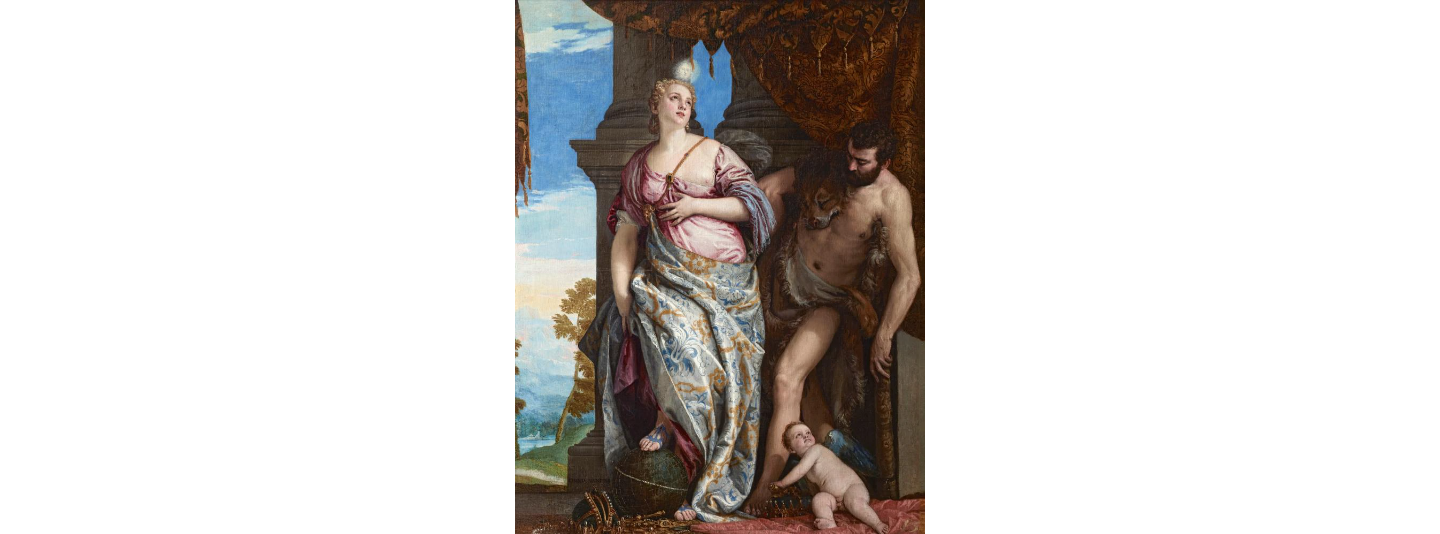
2.) Paolo Veronese, “Wisdom and Strength” ca. 1565 (This itty bitty jpg really does not do it justice, it does have to be seen in person to be appreciated.)
3.) I had an epiphany in the Breakfast Room, when a fellow museum-goer disdainfully remarked that the Corot paintings “are all so soft” (read: the same). But look at these paintings, each one a small glory!


And I later thought to myself, if I were an overwhelmingly wealthy person, maybe I wouldn’t invest so much money7 or floorspace on the rooms where I eat or sleep in comparison to where I spend time during the day. The rooms on the second floor height-wise as well as in overall size are more cramped than those that grace the first floor. Even still, I suppose I would put plenty of pictures that I’d enjoy looking at as I have my morning coffee too, no matter the size of the room. Even if the Frick family’s opulent home-museum may appear so un-relatable, so unapproachable, beauty is something we can all adore and take heed of, and so I say why not people our spaces with art that light up the days of our lives before the sun is up!

Stay tuned for Part Two where an excerpt or two from my commonplace book, seascapes and woodlands, and facing one’s fears collide on the same (virtual) page!
The adjective is formed from the past participle of the verb “commuovere.” If you read/speak Italian, the link to the Treccani etymology with literary examples is worth a quick read.
It’s even one of the first books I wrote about in my “Desert Island Books” column here on Substack! You can listen me read the opening paragraph of the novel in English and my beginner’s Turkish in the same post too.
Just a sampling of some of the New York Times and New Yorker articles about the Frick reopening and renovation:
“The Frick Glows With a Poetic, $220 Million Renovation” by Michael Kimmelman, photos and video by Lila Barth, March 15, 2025, New York Times
“A Guided Tour: Inside the Splendor of the New Frick” by Holland Cutter, photos and video by Adrianna Glaviano, March 19, 2025, New York Times
“At the New Frick, Magicians Comes out of the Woodwork” by Patricia Leigh Brown, photos by Vincent Tullo, April 1, 2025, New York Times
“The Frick Returns, Richer than Ever” by Adam Gopnik, April 6, 2025 The New Yorker
From Mary Oliver’s 2010 collection, Swan: Poems and Prose Poems, pg. 5.
It’s because of the Greek etymology that my now deactivated WordPress originally had the veritable mouthful of a title of in luce versus, {in light there is verse}, which of course riffed on the Latin phrase in vino veritas, {in wine there is truth}.
I suppose now that film cameras are officially cool again (tongue in cheek!), I probably could get the broken mirror repaired. Once the first digital cameras started to come on the market, everyone was saying it’s the end of film (kind of like the end of books, the death of the novel, etc…). My grandfather was an engineer and wasn’t a technophobe in the least. His Leica may have been his favorite camera and prized possession, but he used and I remember him with his Minoltas the most.
As Milton Esterow wrote in his article for the New York Times, “[Henry Clay Frick] Built the Frick Collection With Passion, Patience and Bargaining,” April 24, 2025: “Frick said that it made sense to keep some of your wealth in art that surrounds you, not just invested in bonds. With the former, he said, “you can draw your dividend daily.”” (emphasis in bold is mine).