

Notes from the Ineffable: Part 2
Blog | Commonplace Book | Facing One's Fears | Mare e Montagna (Seas and Mountains)


Hello all and welcome! If you didn’t read Notes from the Ineffable: Part 1, no worries because this post is not really a sequel in that sense. It does continue the theme of being moved by something, or as I shared in that post, the Italians call being commosso/a with something (or someone). So I’ll repost the definition here just briefly.
Although I suppose it isn’t the most untranslatable word in Italian, I still find it hard to convey the density and nuance of commosso.1 In English, you can say that something or someone “moved you” or “touched you.” But as a more than a bit of a grammar nerd, I like the inherent shape of the word in Italian that shows you are moved actively “with,” not just passively “by” something or someone. Whether it’s a piece of writing or a painting or a sculpture, or a person, or a seascape or a mountain view, it seems to me that in Italian it is both the subject and the object, the viewer and the viewed, that are set in motion because of feelings of intense joy or intense sadness, or sometimes even a combination of the two.
This post was inspired by both experiences and literature. The short story is that I was inspired to go through my commonplace book and pick out quotes about love, but I ended up stumbling upon Thomas Mann’s words from Buddenbrooks, which I will share below, and when I reread them they made complete sense to me again. Unlike Thomas Buddenbrooks though, I don’t think that the sea is only for the sick and the mountains only for the healthy. I’ve found that even (very very small!) mountains are helping me to heal myself, as well as the sea. And so this post is about the beginning of that journey, which as you may know from my post on the Mental Health Diaries was interrupted, but is continuing now. Nature is a part of my healing, but it cannot do all the work for me.

We might as well start with Exhibit A, this excerpt, and although it’s a bit long, it’s excellent and I found it so helpful that I encourage you to read it, digest it, re-read again as often as you’d like. The picture shows my atrocious handwriting, and below that is the legible typed-up version.
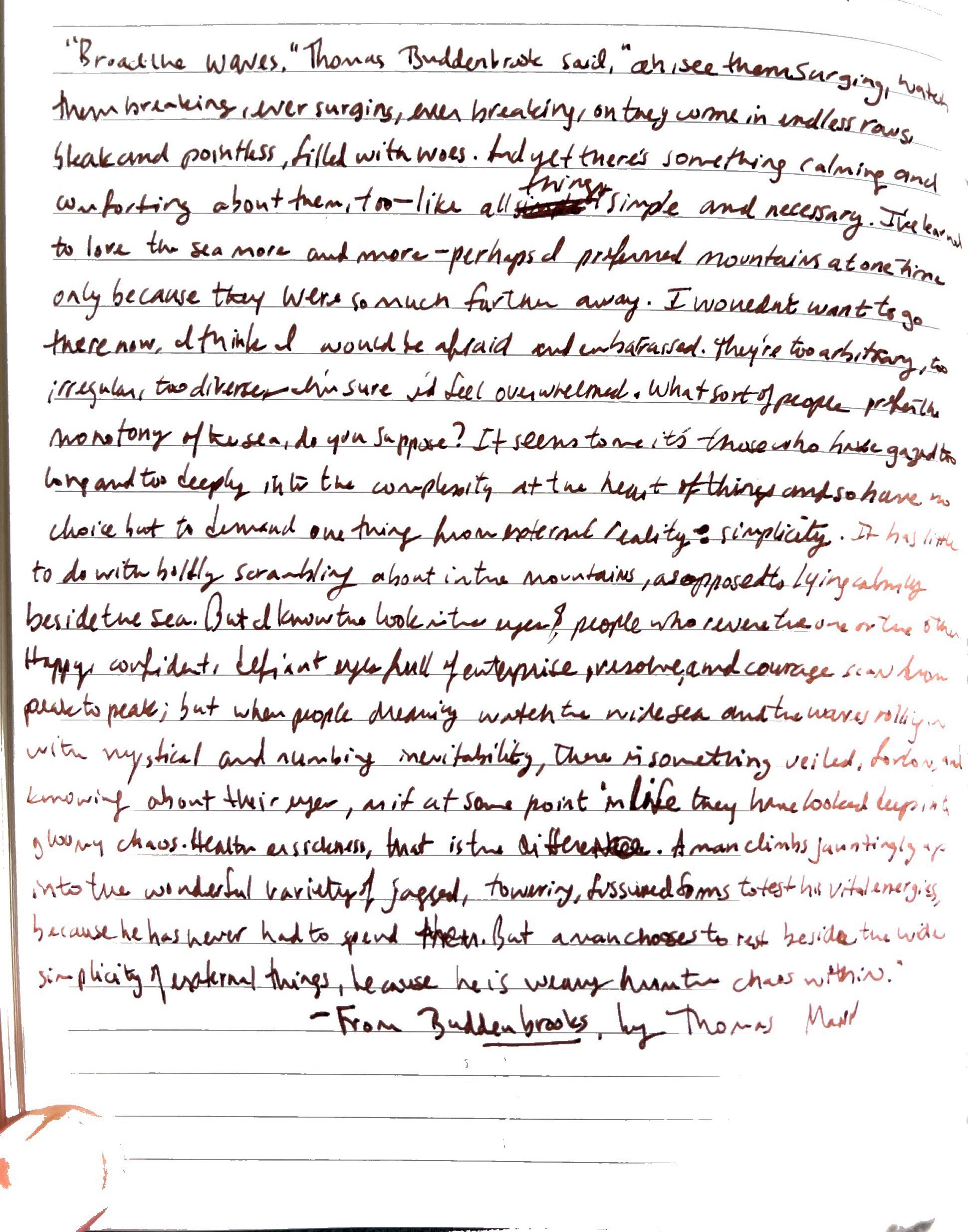
“Broad the waves,” Thomas Buddenbrook said, “ah, see them surging, watch them breaking, ever surging, ever breaking, on they come in endless rows, bleak and pointless, filled with woes. And yet there’s something calming and comforting about them, too-like all things simple and necessary. I’ve learned to love the sea more and more-perhaps I preferred mountains at one time only because they were so much farther away. I wouldn’t want to go there now. I think I would feel afraid and embarrassed. They’re too arbitrary, too irregular, too diverse—I’m sure I’d feel overwhelmed. What sort of people prefer the monotony of the sea, do you suppose? It seems to me it’s those who have gazed too long and too deeply into the complexity at the heart of things and so have no choice but to demand one thing from external reality: simplicity. It has little to do with boldly scrambling about in the mountains, as opposed to lying calmly beside the sea. But I know the look in the eyes of people who revere the one or the other. Happy, confident, defiant eyes full of enterprise, resolve, and courage scan from peak to peak; but when people dreaming watch the wide sea and the waves rolling in with mystical and numbing inevitability, there is something veiled, forlorn, and knowing about their eyes, as if at some point in life they have looked deep into gloomy chaos. Health or sickness, that is the difference. A man climbs jauntingly up into the wonderful variety of jagged, towering, fissured forms to test his vital energies, because he has never had to spend them. But a man chooses to rest beside the wide simplicity of external things because he is weary from the chaos within.
- Buddenbrooks by Thomas Mann {translation by John E. Woods}

Maybe it wasn’t the summer I conquered my fears, (or the autumn I conquered them either…), but it was the summer I aspired to conquer fear itself. And like many aspirations, I have had to accept the harsh reality of my limitations. It’s not that I don’t still aspire to the heights, it’s just that I know it will take me far, far longer to ever reach them. In my youth I was more fearless, but I don’t think anyone ever is entirely. But this summer, I’d had enough of my anxiety and being in fight, flight, freeze or fawn mode the majority of every day. After years of struggling, this summer I made a pact to branch out and reclaim a bit of the world and its beauty for myself. One thing I’ve learned in therapy is that on the other side of fear and discomfort is learning and growth. I’m hoping my love of learning will see me through this arduous journey.
I’m fortunate to have had many external points of inspiration to undertake this in addition to my internal compass seeking to realign itself with the pulse of the earth and such people in it. I won’t say who, but I saw someone taking a cold swim in September. I may never do a full polar plunge on New Year’s Day, but after reading and hearing about the benefits of cold sea water, I was inspired to dip my feet in at my local beach, to experience it myself. Also, my younger brother’s looking at the stingrays at the touch tank at our local aquarium and never putting his hand in, at least, not until I got brave and did so too. He is the one of the people who has taught me that sometimes life makes you learn to pet stingrays {in the touch-tank, not in the wild, it goes without saying}. As Italo Calvino would write in The Baron in the Trees: “‘Rebellion cannot be measured by yards,’ said [Cosimo’s father]. “Even when a journey seems no distance at all, it can have no return.’” Like Cosimo, I too had embarked on a seemingly quixotic journey, not to live my life in the trees, but to be more rooted in the natural world, which I hoped would help me become more in tune with not just nature, but with my family and friends and the human world around me too.
I sought to, if not conquer, then to at least start to alleviate some of my anxiety by embarking on my own form of gradual exposure therapy. I can now wade into the sea on cold mornings and not be entirely freaked out by every brush of seaweed against my legs. Now I can go in deeper, if the waves had been any higher I’d have to say I’d been married to the sea.2
From those morning trips to my favorite local patch of beach, I was also inspired to embrace the world aquatic at our local Aquarium, The Maritime Center at Norwalk. My younger brother loves water but he is not a big fan of sharks, and stingrays are in the shark family. But every time we’d go to the Aquarium together he had to watch the rays in the touch tank swim by for a while before checking out the seals, octopus, otters, jellyfish, sea turtles, among others. And so one trip, I decided I could get my hands in the tank and pet the stingrays like the aquarists and volunteers showed us, and help my brother touch them too. Now we don’t just watch the rays, we say hi and pet them and thank them for the splashes whenever we visit. Here is a nice video clip from the Maritime Center that shows the cow-nose stingrays and why touch tank exhibits are helpful for community engagement.
You’re entitled to your opinion about aquariums and zoos keeping animals that are meant to be wild and free. Certainly they are, that’s no question. But not everyone who loves the ocean will be able to become a scuba diver and an aquarist and a marine biologist. When I saw over the summer an episode from “Our Oceans,” the BBC documentary narrated by Barack Obama on Netflix, about the manta rays in the Indian Ocean, I cried when the rays were injured by boats and fishing gear. It made me want to forsake humans — how can one species cause so much damage to so many the world over??
A few years earlier in 2022, I had listened to the National Geographic podcast, Overheard, about one woman who went undercover to find out about the seafood trade in Asia and why manta rays had become entangled in it. The story stayed with me, but when I listened I didn’t break out the tissue box, I didn’t feel the desperation to do something about it in my own back yard. There is something primal about experience, and although it can be appreciated in writing or visual art or storytelling, it cannot be replaced. I think I was more touched, again as the Italians say, commossa, because I had learned the appreciate stingrays up close and from there I wanted to learn about the challenges they face during climate change and other human travesties. For as Shakespeare wrote in Measure for Measure: “Love speaks with better knowledge, and knowledge with dearer love.” I think the learning and growth we can experience from discomfort and facing hard things are expressions of love, a love for the world soul, anima mundi. Those manta rays have been one global catalyst for me to think about how I can act locally, in addition to my beloved ospreys of course!
And thirdly for anyone still keeping track after all those detailed digressions, I was also inspired to go not just to the sea, but also to the mountains by the above lines in Thomas Mann’s Buddenbrooks from my commonplace book. Even if I don’t agree with the stark black-white contrast between health and sickness he writes of the mountains and the sea, I do think it’s easier to climb mountains after you have let the sea start to heal you a bit, at least in my case.
While my favorite local hiking trail, around Lake Mohegan, may not be a mountain and it is certainly no Everest, (it’s become such an unofficial official dog park that I’ve been asked multiple times over the year’s “Where’s your dog?” because why would anyone go there without a dog, lol?). But for me to go there before the first frost, which even five or seven years ago was more likely to be by late September/early October than late October/mid—November (an entire MONTH, people!), because of my phobia of snakes, is a big deal.
As my hiking season got shorter and shorter, this year I decided to give it back to myself. And on the last stretch of my hike that opens out of the forest on to Lake Mohegan, I have found a way to thank Mother Earth/Gaia/Pachamama/the Sumerian goddess Ki for giving me back the world I hold so dear. By the lake during the summer and into the fall, people are allowed to fish along the shore, but they are atrocious about leaving meters of fishing line and silicone lures and plastic wrap (it’s disgusting really) along the water’s edge, and if I had waited until the ground were frozen solid in the depths of winter, I wouldn’t have seen any of it.
I wouldn’t have been inspired to contact the foundations that look after the grounds, Friends of Lake Mohegan and Sustainable Fairfield, and ask them about spreading awareness and installing specific fishing line disposals that keeps them out of waterways and away from birds and their nests. As Enric Sala wrote in The Nature of Nature, I too refuse to be “writing the obituary of the oceans.” I refuse to be the bard of death and destruction, I want to sing out and celebrate the steps people can take to do good in their own proverbial or actual backyards to make the world a better place, one patch at a time.
And I feel like Mother Earth knows a kindred spirit when she sees one. For my efforts, every hike is not only joyful, but she has given me other gifts in return.3
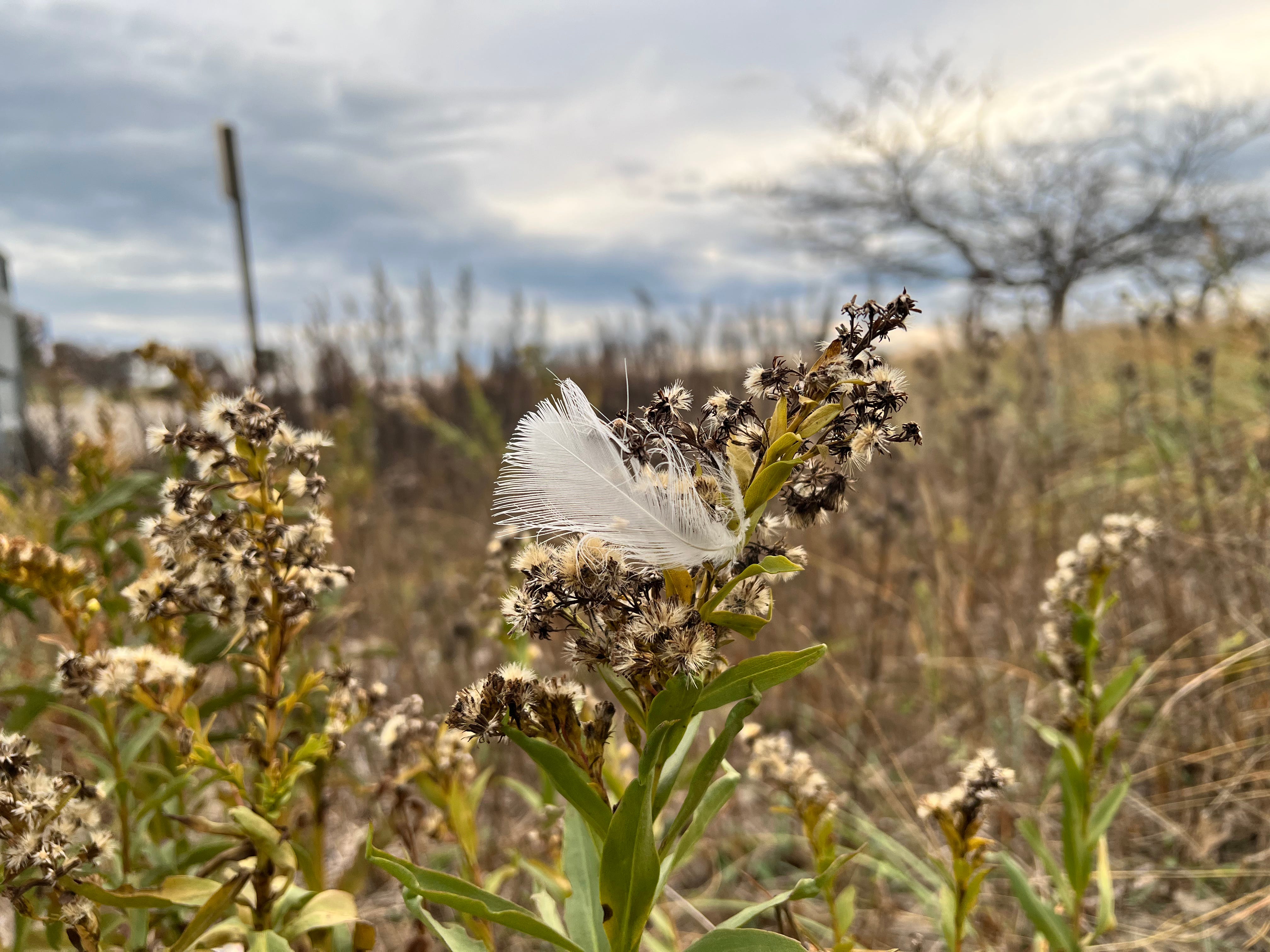
The sight of a pair of star-crossed Cardinal feathers on the trail. A juvenile Red-tailed Hawk on a tree maybe fifteen feet ahead of me and only 10-12 feet up, closer than I’ve ever seen one soaring in the sky or perched high in the Red Maple tree in our backyard, which the resident Blue Jays have never allowed to rest for long. While the trees are still green, a wind that rattles the orange leaves to the ground in a beautiful and melodic shower for twenty or thirty seconds at the most with no one else around so I can enjoy the show. A field of goldenrod, even if planted rather than dispersed (unlike how I picture Henry Wadsworth Longfellow’s serendipitous field of daffodils in “I wandered lonely as a cloud”) is still a marvel to behold. The tree, a giantess, that has fallen long ago, I remember her only like that though, she does not wither where she lays. But rather new trees grow up beside her, with green leaves still trembling in the wind. The asters growing out of the moss on top of a boulder. And the lake like a mirror for a white-patch clouded sky.

Such gifts with no boxes or packages in sight, can we imagine such delights filling our lives? If I had waited until the frost, I would’ve missed this turning, this summer into fall, my favorite season, and I couldn’t possibly abide that. Some are mental pictures only, but some are preserved in pixels too, which you can see in the gallery below.
This journey I’ve embarked on, I thought I was just trying to save myself, but now I want to eventually look beyond myself and be the change I want to see in the world. When I think I should give up hope, admit to being just one person, how can I make a dent, how can I make a difference? But as José Andrés has said before, “we are not few, we are the many.” Famous and not so famous people are making a difference on the ground by fighting for our home, fighting for the trees, the rivers, and the seas. And so I add my voice to the chorus, and am most likely already preaching to the choir, but maybe together we can roar loud above the din, higher than the loudest crashing wave of the sea? Louder than any thunderbolt? Bring me your storms, your hurricanes, because there lies a fire within me that will not bow out. This world is immeasurably beautiful, and I don’t just want to see it, I want to be unapologetically alive in it and for it every single day.
So yes, full disclosure I would not call myself cured or fearless. But I do feel less reactive, less afraid, and if cured isn’t going to be on the table for a good while yet, I’ll take moving towards “better” any day. For now :-) .


The adjective is formed from the past participle of the verb “commuovere.” If you read/speak Italian, the link to the Treccani etymology with literary examples is worth a quick read.
The reference is not based on my own imagination, but comes from a book I read as a teenager called Stravaganza: City of Masks by Mary Hoffman. In her books, in her historical fiction fantasty alternative rendition of Venice, called Bellezza, in the country of Talia (Italy), it is a Duchess that rules Venice not a Doge, and the annual wedding ceremony commemorating the marriage of the city to the lagoon is not of a Doge tossing a gold ring into the sea, but of the Duchess being lowered legs first into the sea until the water reaches a certain point on her legs}.
See Robin Wall Kimmerer's Braiding Sweetgrass entitled “The Gift of Strawberries” and “The Honorable Harvest” stand out in my mind especially on this topic of the the misunderstanding of the term “Indian giver,” which actually stems from indigenous knowledge and respect for reciprocity, not as any base quid pro quo capitalist rationale.